The best compact MIDI controllers give producers hands-on control without taking over a desk, backpack, or mobile setup. This lineup covers mini keyboards, pad controllers, sequencers, and control surfaces for different workflows and budgets.
Whether you need expressive keys, finger-drumming pads, mixer control, or a portable songwriting tool, these options make it easier to choose the right balance of size, features, and playability.
Best 10 Compact Midi Controllers Picks for 2026
Best All-Arounder

- 25 velocity-sensitive mini keys with eight MPC pads
- Color display, knobs, arpeggiator, chord, and scale modes
- USB-C, full-size MIDI Out, and mapped DAW controls
Best For: Producers needing keys, pads, and hands-on DAW control
Best Workflow Focus

- 25 velocity-sensitive slim keys and eight RGB pads
- Eight encoders, four faders, display, and arpeggiator
- Includes Ableton Live Lite, Analog Lab Intro, and UVI Model D
Best For: Home producers wanting an accessible all-in-one layout
Best Slimline Mixer Control

- Low-profile USB control surface for DAW workflows
- Eight-channel mixer control with mute functions
- Compact 12.8-by-3.27-by-1.18-inch design
Best For: Users needing track control without keys or pads
Best for Hardware Sequencing
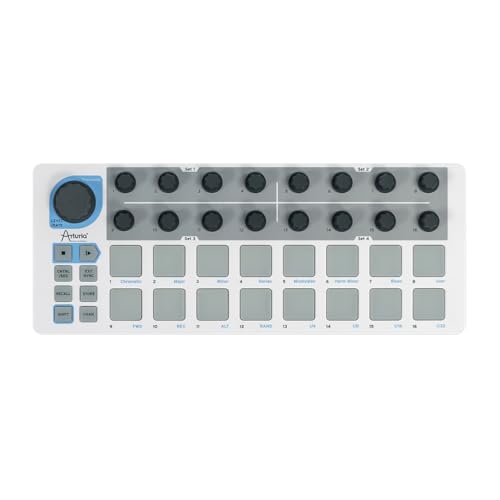
- 16 velocity- and pressure-sensitive pads with 16 encoders
- Controller and step-sequencer modes can run together
- MIDI, USB, and CV connectivity with 16 pattern memories
Best For: Electronic musicians building software-and-hardware rigs
Best Pad Controller

- 8 RGB MPC-style pads
- 8 assignable Q-Link knobs
- USB-powered with four presets
Best For: Mobile beat makers and DAW producers
Best Compact Keyboard

- 25 velocity-sensitive slim keys
- Two touch strips and four buttons
- Includes presets and Ableton Live Lite
Best For: Portable keyboard-based music production
Best for Ableton Live

- 64-pad RGB clip-launch matrix
- 8 channel faders plus master fader
- 1:1 Ableton Live integration
Best For: Ableton Live performance and clip launching
Best Compact Two-Handed Controller
Arturia MiniLab 37 MIDI Keyboard Controller

- 37 slim keys support two-handed play
- DAW-integrated pads, faders, and display
- Arpeggiator and Chord mode included
Best For: Space-conscious studios and mobile rigs
Best Compact Standalone Workflow
Akai MPK Mini Plus 37-Key Controller

- 37 keys cover three full octaves
- Built-in 64-step sequencer works without a computer
- CV/Gate and MIDI I/O support external hardware
Best For: Hybrid DAW, modular, and synthesizer setups
Best Ultra-Compact Beat Maker
Akai MPK Mini MK3 25-Key Controller

- 25 velocity-sensitive mini keys save desk space
- Eight MPC pads and eight assignable knobs
- Software bundle includes MPC Beats and sounds
Best For: Beat makers, home studios, and portable setups
Best All-Arounder – Akai MPK Mini IV
The Akai MPK Mini IV is a strong all-purpose choice among compact midi controllers. Its 25 velocity-sensitive mini keys, MPC pads, assignable knobs, display, and USB-C connectivity cover keyboard parts, beat making, sound control, and portable production.
Best For: Producers who want one compact controller for keys, pads, DAW control, and travel setups.
Pros:
- Combines 25 mini keys, eight RGB MPC pads, eight 360-degree knobs, and a color display.
- Includes chord, scale, and arpeggiator features for songwriting and live jamming.
- Offers USB-C, full-size MIDI Out, pre-mapped DAW controls, and bundled software.
Cons:
- Mini keys may be less suitable for players who prefer a full-size keyboard feel.
- Its broad feature set may take time for beginners to learn fully.
The MPK Mini IV is especially versatile if you want keyboard performance and pad-based beat production in one portable unit. Its software integration and standalone MIDI output also make it flexible across studio, mobile, and live workflows.
Best Workflow Focus – Arturia MiniLab 3
The Arturia MiniLab 3 is a streamlined option among compact midi controllers, pairing 25 velocity-sensitive keys with pads, encoders, faders, a display, and an arpeggiator. It is designed to keep common production tasks within easy reach.
Best For: Home producers who want an approachable controller with keyboard, pad, mixer, and software features.
Pros:
- Provides 25 slim keys, eight RGB-backed pads, eight rotary encoders, and four faders.
- Includes pitch-bend and modulation touch controls, a clickable browsing knob, and a mini display.
- Comes with Ableton Live Lite, Analog Lab Intro, UVI Model D, and a five-year limited warranty.
Cons:
- The slim synth-action keys are not a substitute for a full-size piano-style keyboard.
- Its supplied connectivity is USB, with no broader connection details listed in the notes.
The MiniLab 3 makes sense for users who value a tidy, hands-on layout over specialized sequencing features. Its combination of controls and included software gives a new setup a practical starting point.
Best Slimline Mixer Control – Korg nanoKONTROL2
The Korg nanoKONTROL2 takes a different approach to compact midi controllers: it is a low-profile control surface rather than a keyboard. Its eight-channel layout and dedicated controls are suited to adjusting software tracks while keeping desk space to a minimum.
Best For: DAW users who need compact track control and do not need keys or performance pads.
Pros:
- Uses a slim, low-profile design measuring 12.8 by 3.27 by 1.18 inches.
- Provides control for eight mixer channels and includes mute controls.
- Supports major DAW programs and includes a USB cable.
Cons:
- It has no traditional keyboard layout, so it cannot play keys or piano parts.
- Its listed feature set is focused on control-surface duties rather than pads, sequencing, or sound generation.
The nanoKONTROL2 is best viewed as a compact companion to a keyboard or pad controller. Choose it when physical track and mute controls matter more than musical input features.
Best for Hardware Sequencing – Arturia BeatStep
The Arturia BeatStep stands out among compact midi controllers by combining a pad-and-knob controller with a step sequencer. Its 16 velocity- and pressure-sensitive pads, 16 encoders, pattern memories, and MIDI, USB, and CV connections support software and hardware-focused setups.
Best For: Electronic musicians who want hands-on sequencing, clip triggering, and control of MIDI or CV gear.
Pros:
- Offers 16 velocity- and pressure-sensitive pads plus 16 encoders.
- Can run controller and sequencer modes simultaneously.
- Includes MIDI, USB, and CV connectivity, along with 16 pattern memories and bundled software.
Cons:
- It does not provide a traditional piano-style keyboard.
- Its sequencing and connection options may be more than needed for simple DAW control.
The BeatStep is a creative choice for users who want compact control beyond note entry. Its combination of step sequencing, clip triggering, and CV compatibility makes it particularly useful in hybrid software-and-hardware rigs.
Best Pad Controller – Akai LPD8 MK2
The Akai Professional LPD8 MK2 is a strong choice for anyone seeking compact midi controllers focused on beat making and tactile DAW control. Its eight RGB-backlit pads and eight assignable knobs fit easily into a laptop-based setup while providing hands-on control for samples, instruments, effects, and mixing.
Best For: Mobile beat makers, producers, DJs, and creators who prefer pads and knobs over a keyboard.
Pros:
- Eight responsive RGB-backlit MPC-style pads for triggering samples, loops, and instruments.
- Eight assignable Q-Link knobs provide tactile parameter and mixing control.
- USB-powered plug-and-play operation works with Mac and PC without drivers or an AC adapter.
- Four programmable preset slots make it easy to recall custom mappings.
Cons:
- It has pads and knobs rather than piano-style keys.
- Its strongest feature set is geared toward beat production and parameter control.
Choose the LPD8 MK2 when portability and immediate pad access matter most. It is especially practical for producers who want compact control that can travel in a laptop bag and work across popular DAWs.
Best Compact Keyboard – Arturia MicroLab Mk3
The Arturia MicroLab Mk3 is one of the more keyboard-oriented compact midi controllers for creators who want playable keys in a small footprint. Its upgraded 25-key slim keybed, touch strips, and USB-C connection make it suitable for mobile music-making and compact studio setups.
Best For: Keyboard players, beginners, and mobile producers who want responsive keys with simple performance controls.
Pros:
- 25 velocity-sensitive slim keys offer a more traditional playing experience than pad-only controllers.
- Two touch strips and four buttons provide intuitive musical and parameter control.
- Small, lightweight, durable, and USB-powered for portable use.
- Includes 500 curated Analog Lab Intro presets and Ableton Live Lite.
Cons:
- The compact keybed is not intended to replace a full-size keyboard.
- Its controls are comparatively streamlined, with four buttons and two touch strips.
The MicroLab Mk3 makes sense when actual keys are a priority but desk space and portability are limited. Its straightforward plug-and-play design also suits creators who want to start making music without a complicated setup.
Best for Ableton Live – Akai APC Mini MK2
The Akai Professional APC Mini MK2 is a performance-focused option among compact midi controllers, designed around Ableton Live clip launching and mixer control. Its 8×8 RGB pad matrix and nine faders give performers a visual, hands-on way to launch clips, manage levels, and work with Drum and Note modes.
Best For: Ableton Live users, live performers, loopers, and home-studio producers who need clip and mixer control.
Pros:
- Sixty-four RGB pads provide visual feedback for launching clips and triggering loops, vocals, and samples.
- Eight assignable channel faders plus a master fader support hands-on mixing and device control.
- Pre-mapped 1:1 integration with Ableton Live 11.2.7 and later simplifies setup.
- USB-powered plug-and-play operation works on Mac and PC, with Ableton Live Lite included.
Cons:
- Its integration and workflow are centered heavily on Ableton Live.
- It does not provide a traditional piano-style keyboard.
For Ableton Live users, the APC Mini MK2 offers unusually comprehensive control in a compact format. It is the better fit when clip launching, visual feedback, and fader-based mixing matter more than playing keys.
Best Compact Two-Handed Controller – Arturia MiniLab 37 MIDI Keyboard Controller
The Arturia MiniLab 37 is a strong choice among compact midi controllers for producers who want a slim footprint without giving up a 37-key layout. Its integrated pads, faders, display, arpeggiator, and Chord mode support hands-on work in a desktop studio or mobile rig.
Best For: Two-handed playing in space-conscious studios, beginner-friendly production, and portable setups.
Pros:
- 37 slim keys provide expanded range for two-handed play.
- DAW-integrated pads and faders offer practical hands-on control.
- Built-in arpeggiator, Chord mode, transposition, and real-time mini display support creative workflows.
- Lightweight, shallow design suits compact desks and mobile rigs.
Cons:
- It has one USB Type-C connection and is listed as compatible with PC, Mac OS X, and Windows setups.
- The larger 37-key layout may take more desk space than a 25-key controller.
The MiniLab 37 prioritizes range and streamlined control in a compact body. Choose it when two-handed play matters more than having the smallest possible controller.
Best Compact Standalone Workflow – Akai MPK Mini Plus 37-Key Controller
The Akai Professional MPK Mini Plus combines a 37-key layout with pads, knobs, sequencing, and expanded connectivity, making it one of the more versatile compact midi controllers for production. Its CV/Gate and MIDI I/O also let it connect with modular gear, sound modules, and synthesizers.
Best For: Producers who want three octaves, hardware connectivity, and computer-free sequencing options.
Pros:
- 37-key layout provides three full octaves for melodic and harmonic performance.
- Built-in 64-step sequencer supports drum and melody or chord tracks without a computer.
- CV/Gate and MIDI I/O expand compatibility with external hardware.
- Eight RGB MPC pads, eight assignable knobs, Chords mode, and Scales mode add expressive control.
Cons:
- Its broader feature set may be more than beginners need for basic DAW input.
- USB connectivity is listed as a single port, so external hardware connections may require a more involved setup.
The MPK Mini Plus is a practical pick when compact size does not have to mean minimal control. Its sequencer and hardware I/O make it especially appealing for hybrid computer-and-synth workflows.
Best Ultra-Compact Beat Maker – Akai MPK Mini MK3 25-Key Controller
The Akai Professional MPK Mini MK3 is a compact midi controller built for beat makers and producers working with limited desk space. Its 25 velocity-sensitive mini keys, MPC-style pads, assignable knobs, thumbstick, and included software focus on portable performance and virtual instrument control.
Best For: Beat production, home studios, and producers who prioritize a small footprint with dedicated pads and controls.
Pros:
- Compact 25-key design is easy to fit into small workspaces and portable rigs.
- Eight backlit velocity-sensitive MPC pads support drums, samples, and DAW control.
- Eight assignable knobs and a four-way thumbstick provide hands-on parameter control.
- Includes MPC Beats, three virtual instruments, 2GB of sound content, and an arpeggiator.
Cons:
- The 25-key layout offers less range than the 37-key controllers in this roundup.
- It uses USB 2.0 Type-B connectivity rather than USB Type-C.
The MPK Mini MK3 keeps the essentials close at hand while taking up very little space. It is the better fit for beat-focused workflows and portable production than for extended two-handed keyboard performance.
How We Picked the Best Compact Midi Controllers
We selected these Compact Midi Controllers by comparing their control layouts, portability, connectivity, software integration, playing surfaces, and suitability for real-world production. The lineup includes 25- and 37-key keyboards, pad-focused devices, a sequencer, and a slim control surface so different types of musicians can find a useful fit.
We also considered whether each controller offers practical value for its intended use. A compact keyboard should be easy to play and transport, while a pad controller should provide responsive triggering and straightforward mapping. Build quality, setup simplicity, and compatibility with common music software are important across every category.
Quick Comparison
| Controller type | Best suited to | What to prioritize |
|---|---|---|
| 25-key keyboard | Portable melodies, bass lines, and chords | Key feel, octave controls, pads, and knobs |
| 37-key keyboard | More comfortable songwriting and two-handed parts | Playing range, desk footprint, and control layout |
| Pad controller | Beatmaking, clip launching, and finger drumming | Pad response, layout, and software mapping |
| Control surface | Mixing and parameter adjustment | Fader or knob access and workflow compatibility |
| Sequencer/controller | Pattern creation and hardware-focused performance | Sequencing tools, sync options, and tactile control |
Key Buying Factors for Compact Midi Controllers
Controller Type and Layout
Start with the controls you use most. Keyboard controllers are the most versatile for composing, while pad units favor drums and clip triggering. A control surface can be more efficient for mixing than a keyboard, and a sequencer may suit pattern-based workflows better than either.
Size, Key Count, and Portability
Twenty-five keys offer excellent portability but may require frequent octave switching. Thirty-seven keys provide more room for chords and melodies while remaining compact. Measure your desk or travel bag, and check whether the controls are positioned comfortably rather than judging size by dimensions alone.
Connectivity and Software Support
USB is standard, but USB-C, MIDI DIN, device compatibility, and power requirements can matter if you plan to connect hardware instruments or mobile devices. Bundled software and deep integration with your preferred DAW can also save setup time.
Performance Controls
Look for velocity-sensitive keys or pads, pitch and modulation controls, knobs, faders, arpeggiators, and transport buttons based on your workflow. Extra controls are valuable only when they are easy to reach and map reliably.
Who Should Buy Which Compact Midi Controllers?
For Portable Songwriting
Choose a compact 25-key keyboard when portability is the priority and you mainly create melodies, bass lines, and simple chord parts. Models with pads, knobs, and built-in performance features offer more flexibility in a small footprint.
For More Comfortable Keyboard Playing
A 37-key controller is the better choice for producers who want more range for two-handed ideas without moving to a full-size keyboard. It is especially useful for songwriting and arranging at a fixed desk.
For Beatmakers and Live Clip Control
Choose a dedicated pad controller if drums, samples, or clip launching are central to your workflow. Prioritize responsive pads and clear software integration over having unnecessary keys.
For Mixing and Hardware Workflows
A slim control surface suits users who want direct access to parameters, while a compact sequencer is a stronger fit for pattern creation and hands-on hardware performance. Match the controller to the way you already make music rather than buying based on feature count alone.