The best plyometric boxes make jump training, step-ups, squats, and conditioning more convenient at home or in a small training space. The right option should match your experience level, available room, preferred height, and tolerance for impact.
We compared foam, wood, and steel designs across multiple sizes and three-in-one configurations to help you choose a stable, practical platform for your workouts.
Best 10 Plyometric Boxes Picks for 2026
Soft-Impact Pick
BalanceFrom 3-in-1 Foam Plyo Box

- Rotates between 16, 20, and 24 inches
- High-density foam softens impact
- Lightweight 10-pound design
Best For: Home users seeking portable, lower-impact training
High-Capacity Choice

- Wooden core with EVA foam cushioning
- Three adjustable training heights
- Supports up to 450 pounds
Best For: Home athletes wanting cushioning and high capacity
Compact Wood Pick

- Rotates through 16, 14, and 12 inches
- Engineered-wood interlocking construction
- Includes textured surface and carry handles
Best For: Compact home-gym strength and conditioning
Easy-Assembly Pick
Amazon Basics 3-in-1 Wooden Plyo Box

- Three marked heights from 12 to 16 inches
- Supports up to 450 pounds
- Pre-drilled holes simplify assembly
Best For: Beginners setting up an indoor home gym
Best Overall Versatility
12/18/24-Inch Metal Plyometric Box Set

- Three heights support progressive training
- Steel build supports up to 500 pounds
- Stackable and equipped with anti-slip features
Best For: Multi-user home gyms and progressive strength or agility training
Best Foam Option
BalanceFrom 3-in-1 Foam Plyometric Box

- Rotates between 20-, 24-, and 30-inch heights
- Foam construction offers softer impact
- Lightweight 16-pound design is portable
Best For: Home users and beginners prioritizing comfort and easy storage
Best Compact Steel Platform
12/18-Inch Heavy-Duty Plyometric Box

- Reinforced steel supports up to 500 pounds
- Trapezoid base and rubber feet promote stability
- Compact platform suits jumps, squats, and HIIT
Best For: Users wanting a sturdy, space-conscious steel training platform
Best Adjustable Set
Yes4All 3-in-1 Wooden Plyo Box
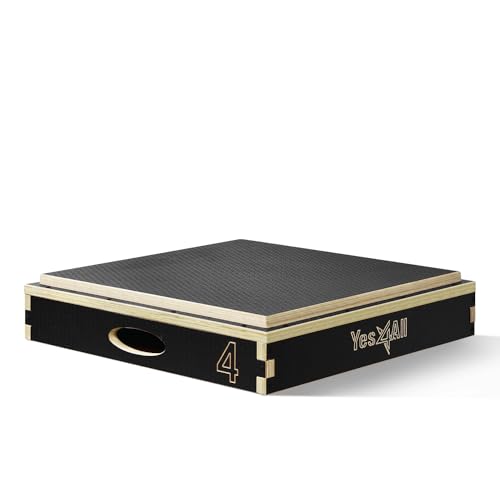
- Stackable heights from 4 to 16 inches
- 22-inch square base with textured top
- 400-pound capacity; one-year warranty
Best For: Adjustable home-gym jump and step-up training
Best Heavy-Duty Pick
3-in-1 Wood Plyometric Jump Platform

- Three heights: 12, 14, and 16 inches
- 400-pound plywood weight capacity
- Pre-drilled holes for simpler assembly
Best For: Compact home training with one adjustable box
Best Heavy-Duty Set
VEVOR Steel Plyometric Jump Box

- Three sizes: 12, 18, and 24 inches
- Steel construction rated to 500 pounds
- Rubber feet and textured silicone tops
Best For: High-capacity home-gym conditioning and jump training
Soft-Impact Pick – BalanceFrom 3-in-1 Foam Plyo Box
If you want versatile plyometric boxes for home workouts, the BalanceFrom 3-in-1 Foam Plyometric Jump Box offers 16-, 20-, and 24-inch training heights by rotating the box. Its high-density foam construction is designed to provide softer impact for jumps, step-ups, HIIT, and agility drills.
Best For: Home users who prioritize lightweight portability and a softer landing surface.
Pros:
- Three height options support progressive training.
- High-density foam helps minimize shin scrapes and soften impact.
- Textured anti-slip surface supports secure foot placement.
- Weighs 10 pounds and includes a 2-year warranty.
Cons:
- Its 250-pound maximum weight recommendation is lower than some wood-core alternatives.
- Foam construction may not provide the same rigid feel as a wooden box.
This is a practical choice for beginners, general fitness, and home HIIT sessions, especially when portability and impact comfort matter more than a rigid platform.
High-Capacity Choice – Yes4All Soft-Padded Plyo Box
Among plyometric boxes for varied home training, the Yes4All 3-in-1 Soft-Padded Plyo Box combines a wooden core with EVA foam cushioning and a vinyl cover. Its three height options and high weight capacity make it suitable for box jumps, step-ups, HIIT, and agility work.
Best For: Users who want a cushioned wooden-core box with a high stated weight capacity.
Pros:
- Three height options accommodate different exercises and progressions.
- Wooden core provides a stable foundation beneath the cushioning.
- Soft EVA foam and vinyl cover help absorb impact.
- Maximum weight capacity is listed at up to 450 pounds.
Cons:
- The supplied size is relatively compact at 16 by 14 by 12 inches.
- The listed warranty is limited to a 30-day return period and 1-year warranty.
The layered construction offers a useful balance of stability and comfort, while the compact format can make storage easier for home-gym users.
Compact Wood Pick – CAP Barbell 3-in-1 Plyo Box
The CAP Barbell 3-in-1 Plyometric Box is a compact wooden option among plyometric boxes, rotating between 16-, 14-, and 12-inch heights. Interlocking panels, countersunk screws, a textured surface, and integrated handles support regular home-gym use.
Best For: Home trainees who prefer a compact engineered-wood box with convenient carrying handles.
Pros:
- Three height settings support jumps, step-ups, and agility drills.
- Interlocking construction and countersunk screws are designed for stability.
- Textured surface adds traction during training.
- Smooth edges and built-in handles improve handling and repositioning.
Cons:
- Its 300-pound maximum weight recommendation is lower than some competing models.
- The compact height range may be less suitable for users seeking taller jump challenges.
With a 16-inch maximum height and 15.4-pound weight, this box suits straightforward indoor strength and conditioning sessions where a smaller footprint is useful.
Easy-Assembly Pick – Amazon Basics 3-in-1 Wooden Plyo Box
The Amazon Basics 3-in-1 Wooden Plyo Box is a straightforward choice for home plyometric boxes, offering 16-, 14-, and 12-inch heights with visible height indicators. It is built for indoor training and includes pre-drilled holes, pilot holes, and instructions for assembly.
Best For: Beginners and home-gym users who want a wooden box with clear setup and height markings.
Pros:
- Three marked heights allow workouts to progress from lower to higher settings.
- Supports up to 450 pounds according to the supplied specifications.
- Wide handles make repositioning easier.
- Sanded edges and included assembly instructions support user-friendly setup.
Cons:
- It requires assembly before use.
- The listed 12- to 16-inch range may not meet the needs of athletes seeking taller platforms.
- It is designed primarily for indoor training.
This model emphasizes accessible home use, with clear height indicators and assembly features that can appeal to beginners building a basic conditioning setup.
Best Overall Versatility – 12/18/24-Inch Metal Plyometric Box Set
If you want plyometric boxes that support progressive training, this three-piece metal set provides 12-, 18-, and 24-inch height options. Its steel construction, anti-slip features, and stackable design make it suitable for varied home-gym workouts.
Best For: Beginners through advanced users who want multiple jump heights for box jumps, step-ups, strength work, and agility drills.
Pros:
- Includes three heights for progressive training.
- Heavy-duty steel construction supports up to 500 pounds.
- Textured silicone tops and rubber feet help improve stability.
- Stackable design simplifies storage and transport.
Cons:
- Metal construction may offer less forgiving landings than foam.
- The three-piece set is heavier to move, weighing about 15.69 kg.
This is the most adaptable option of the group, especially for households or studios where users need different training heights. The sturdy trapezoidal design is practical for demanding workouts, though its metal build may not suit users prioritizing softer landings.
Best Foam Option – BalanceFrom 3-in-1 Foam Plyometric Box
For athletes seeking more forgiving plyometric boxes, this BalanceFrom foam model rotates between 20-, 24-, and 30-inch heights. Its high-density foam body, textured surface, and 16-pound weight make it convenient for home workouts.
Best For: Home users who want adjustable-height box jumps, HIIT, step-ups, and agility work with a softer foam surface.
Pros:
- Three height options are available by rotating the box.
- High-density foam helps provide softer impact and reduce shin scrapes.
- Textured surface helps maintain footing during jumps and step-ups.
- Lightweight 16-pound design is easy to move and store.
Cons:
- Maximum recommended weight is 60 pounds.
- It is not as suitable for heavier users as the steel alternatives.
This is the most approachable choice for beginners and home exercisers who value portability and a softer landing surface. The 60-pound weight recommendation significantly limits its suitability for larger athletes or heavily loaded exercises.
Best Compact Steel Platform – 12/18-Inch Heavy-Duty Plyometric Box
This compact steel platform is a straightforward choice among plyometric boxes, offering a 12-inch training height and heavy-duty support. Its trapezoidal base, textured top, and rubber feet are designed for stable box jumps, step-ups, and conditioning exercises.
Best For: Users who want a durable, space-conscious steel platform for home or gym training.
Pros:
- Reinforced steel construction supports up to 500 pounds.
- Wide trapezoid base helps minimize movement during use.
- Textured top and rubber feet provide added grip and floor protection.
- Works for box jumps, Bulgarian squats, push-ups, and HIIT circuits.
Cons:
- The supplied details list a 12-inch size, offering less height flexibility than the other options.
- Steel construction may be less forgiving if a jump is missed.
This model suits buyers who prefer a strong, compact platform rather than a multi-height set. It delivers the highest stated weight capacity in a simple format, but users seeking adjustable progression may prefer one of the other boxes.
Best Adjustable Set – Yes4All 3-in-1 Wooden Plyo Box
If you want plyometric boxes that can adapt to different exercises and ability levels, the Yes4All 3-in-1 wooden set offers stackable height options. Its broad 22-inch footprint, textured top, and plywood construction suit jumps, step-ups, and box squats in a home gym or outdoor workout area.
Best For: Users who want adjustable, stackable height options and a high stated weight capacity.
Pros:
- Stackable pieces provide five height options from 4 to 16 inches.
- Wide 22-by-22-inch base is designed for stability.
- Hexagon-textured top helps reduce slipping during workouts.
- Supports up to 400 pounds and comes in two colors.
Cons:
- The supplied dimensions describe a low-profile 2.4-inch product height, so confirm the configuration before ordering.
- Stackable pieces may require setup between height changes.
This is a flexible choice among plyometric boxes when modular height adjustment matters more than a single fixed platform. The included one-year warranty and 30-day return description add useful purchase reassurance.
Best Heavy-Duty Pick – 3-in-1 Wood Plyometric Jump Platform
This compact wooden option is a straightforward pick for home users comparing plyometric boxes with multiple training heights. The 3-in-1 design switches between 12, 14, and 16 inches, while its plywood construction is rated for up to 400 pounds.
Best For: Beginners and experienced athletes who want one compact wooden box with three height settings.
Pros:
- Three height options cover 12, 14, and 16 inches.
- Plywood construction has a stated 400-pound capacity.
- Pre-drilled holes are intended to simplify assembly.
- Suitable for jumps, squats, and conditioning work.
Cons:
- Only one box is included.
- The listed 16-by-14-by-12-inch dimensions provide less base area than larger platforms.
- The notes do not specify a textured or non-slip top.
Choose this model if you prefer a single wood platform and a limited range of practical heights. Its compact footprint may be convenient for home storage, but users wanting broader landing space should compare the dimensions carefully.
Best Heavy-Duty Set – VEVOR Steel Plyometric Jump Box
For shoppers seeking plyometric boxes with a higher stated load rating, the VEVOR set combines steel construction with three platform sizes: 12, 18, and 24 inches. Trapezoidal frames, rubber feet, and textured silicone tops are designed to support jumps, step-ups, push-ups, and strength training.
Best For: Home-gym users who want a three-piece steel set with a 500-pound capacity and multiple platform sizes.
Pros:
- Includes 12-, 18-, and 24-inch platforms for varied training.
- Steel tubing and welded construction provide a durable structure.
- Rubber bottom pads and textured silicone surfaces support grip.
- Boxes can be stacked or disassembled for storage.
Cons:
- The 39.7-pound set is heavier than many wooden options.
- Assembly is required before use.
- The supplied notes list a maximum height of 4.72 inches, which conflicts with the advertised 12-, 18-, and 24-inch sizes.
This is the most robustly specified set in the group, particularly for buyers prioritizing steel construction and a high capacity. Verify the size details and available storage space before purchasing.
How We Picked the Best Plyometric Boxes
We focused on the features that matter most during repeated jump and step-up sessions: construction, stability, usable height options, surface traction, portability, and setup. The lineup includes soft-sided boxes that can reduce hesitation during missed jumps, wooden models that offer a firm training surface, and steel platforms designed for heavy-duty use.
We also considered whether each box works for more than one movement. Three-in-one designs can provide several training heights by rotating the box, while single-height platforms may suit buyers who want a simpler, more compact setup. Because users have different experience levels and spaces, no single material or shape is ideal for everyone.
Quick Comparison
| Box type | Best for | Main advantage | Potential trade-off |
|---|---|---|---|
| Foam | Beginners and home gyms | More forgiving landings | May feel less rigid |
| Wood | General strength and jump training | Firm, versatile platform | Harder landing surface |
| Steel | Heavy-duty conditioning | Strong and durable construction | Can be heavier and louder |
| Three-in-one | Progressive training | Multiple heights in one box | Requires enough floor space to rotate |
Key Buying Factors for Plyometric Boxes
Height and Progression
Check every available height rather than relying only on the product name. Lower settings are useful for learning landing mechanics and building confidence, while taller settings demand more power and mobility. A three-in-one model is often the most practical choice for shared households or progressive workouts.
Stability and Construction
A box should remain planted when you jump, step, or transition between movements. Look for a broad base, reinforced joints, non-slip feet, and a top surface that does not shift. Wooden and steel models usually feel firm, while foam models prioritize a more forgiving contact surface.
Surface Grip and Landing Comfort
Non-slip coverings, textured tops, and secure padding can improve control. If you are new to box jumps or train in a confined area, a soft-padded model may be preferable. Experienced users who want maximum responsiveness may favor a rigid platform, provided they can land safely.
Footprint, Storage, and Noise
Measure your workout area before buying, including the clearance above the box and space for a safe landing. Wood and steel can create more noise on hard floors, so a rubber mat may be worthwhile. Also check the assembled dimensions and whether the box is easy to move.
Who Should Buy Which Plyometric Boxes?
Beginners: Choose a lower-height foam or padded model with several settings. It can make practice less intimidating while you develop takeoff and landing technique.
General home-gym users: A three-in-one wooden box offers a useful balance of firmness, versatility, and value for jumps, step-ups, squats, and conditioning.
Advanced athletes: Consider a rigid wood or steel platform with the height and stability needed for repeated explosive work. Confirm that the surface and base remain secure during fast sessions.
Limited-space users: Prioritize compact dimensions and a model that can be stored easily. Whichever box you select, place it on a level, non-slip surface and begin at the lowest comfortable height.