The right audio mixer can make a podcast studio easier to control, more adaptable for guests, and better prepared for recording, streaming, and remote production. The best choice depends on how many microphones you use, whether you need onboard effects, and how much hands-on control you want.
We selected 10 audio mixers spanning beginner-friendly interfaces, compact analog boards, and feature-rich podcast consoles. Use the buying guide below to narrow the list by workflow, connectivity, and budget.
Best 10 Audio Mixer for Podcast Studio Picks for 2026
Feature-Packed Pick

- XLR preamps with 48V phantom power
- 11 customizable sound pads
- Instrument input and live-streaming connections
Best For: Podcasters and streamers wanting built-in effects and flexible inputs
Simple Analog Choice

- Six-channel analog mixer
- D-PRE preamps with EQ and filters
- Rugged, compact metal chassis
Best For: Basic analog podcast, lecture, and performance setups
Complete Podcast Workstation

- Four mic inputs and headphone outputs
- 14-track recording to SD card
- Touchscreen, sound pads, and editing software
Best For: Multi-person podcasts and integrated live production
Streamer-Friendly Starter

- XLR input with 48V phantom power
- Independent channel volume controls
- Mute, monitor, sound effects, and RGB lighting
Best For: Solo streamers and beginners using an XLR microphone
Best All-in-One Pick

- Two XLR inputs with up to 60dB gain
- Eight customizable sound-effect pads
- USB-C, Bluetooth, loopback, and battery power
Best For: Co-hosted podcasts, livestreams, and mobile-friendly creator setups
Best for Multi-Input Studio Use
FULUODE CT-80S 8-Channel Mixer

- Eight channels for microphones and instruments
- USB recording, Bluetooth, MP3, and reverb
- Includes 48V phantom power and LED display
Best For: Podcast studios that also host karaoke, music, conferences, or live events
Best Compact Sub-Mixer
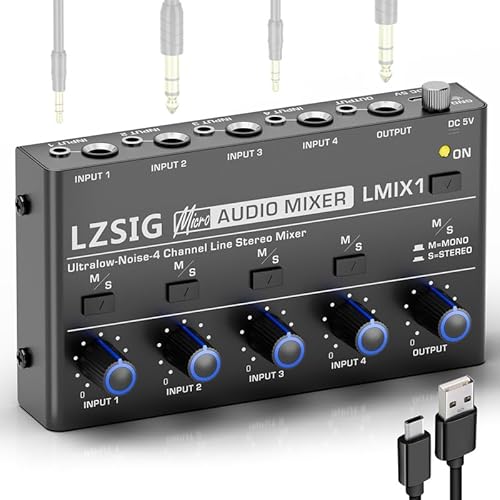
- Combines four line sources into one output
- Accepts 3.5mm and 6.35mm TS/TRS cables
- Compact, low-noise mono/stereo routing
Best For: Small studios needing basic line-source sub-mixing
Flexible 6-Channel Pick

- Four XLR inputs with 48V phantom power
- Bluetooth and USB playback support
- 3-band EQ and 16 DSP effects
Best For: Podcast studios and small live setups needing flexible inputs and effects
Compact Podcast Pick

- Plug-and-play PC recording via USB-C
- Two mic/instrument combination inputs
- 99 DSP effects and headphone monitoring
Best For: Compact podcast and streaming workstations
High-Capacity Studio Choice

- Eight XLR or 1/4-inch input channels
- USB, Bluetooth, and flash-drive support
- Per-channel EQ, gain, FX, and PFL controls
Best For: Multi-person podcasts and larger recording setups
Feature-Packed Pick – MAONO AME2
The MAONO AME2 is a versatile audio mixer for podcast studio setups that need microphone control, sound pads, instrument input, and live-streaming connectivity. Its XLR preamps, phantom power, USB-C connection, and built-in effects make it suitable for creators who want more production features without adding separate hardware.
Best For: Podcasters, streamers, voice-over creators, and musicians using analog microphones or instruments.
Pros:
- Supports XLR condenser and dynamic microphones with up to 60dB gain and 48V phantom power.
- Offers 11 customizable sound pads, including looping and longer recording options.
- Includes instrument input, reverb, auto-tune, tone controls, sidechain, music-only, and loopback features.
- Works with PCs, smartphones, tablets, cameras, Windows, and Mac OS.
Cons:
- USB microphones are not supported.
- The many controls and effects may take time to learn.
- The package contents listed do not include an XLR microphone.
Choose the AME2 if your audio mixer for podcast studio needs go beyond basic mixing. It is especially appealing for interactive shows and live streams that use sound effects, instruments, and multiple connection types.
Simple Analog Choice – Yamaha MG06
The Yamaha MG06 is a compact, straightforward audio mixer for podcast studio users who prioritize analog sound control over USB features. Its six-channel layout, D-PRE preamps, EQ, high-pass filters, and one-knob compressors provide practical tools for recording, lectures, and small performances.
Best For: Small analog recording setups, lectures, performances, and users who already have separate recording hardware.
Pros:
- Six-channel design provides a useful amount of analog mixing capacity.
- Studio-grade D-PRE preamps are designed for natural bass and smooth highs.
- Three-band EQ, high-pass filters, and one-knob compressors simplify sound shaping.
- Rugged powder-coated metal chassis and compact two-pound build suit portable use.
Cons:
- It has no USB connectivity.
- It does not provide the podcast-specific sound pads or editing features found on larger digital mixers.
- A separate computer interface or recorder may be needed for digital recording.
The MG06 is a good fit when you want dependable analog mixing and essential channel processing without a built-in production system. Confirm that your studio has the required recording or interface equipment before choosing it.
Complete Podcast Workstation – TASCAM Mixcast 4
The TASCAM Mixcast 4 is a complete audio mixer for podcast studio production, combining mixing, recording, USB interfacing, and touchscreen control. Four microphone inputs, four headphone outputs, trigger pads, Bluetooth, and direct 14-track SD recording make it well suited to multi-person shows and live content production.
Best For: Multi-host podcasts, live streams, event production, voice-over work, and creators who want onboard recording.
Pros:
- Provides four mic inputs and four individual headphone outputs for group recording.
- Records up to 14 tracks directly to an SD card.
- Includes eight banks of customizable illuminated sound pads.
- Supports Bluetooth, auxiliary phone input with mix-minus, USB connectivity, and TASCAM Podcast Editor.
Cons:
- Its larger feature set may be more than a solo podcaster needs.
- The unit weighs about 2550 g, making it less convenient for frequent transport.
- It is a corded device rather than a battery-powered recorder.
If you need a centralized workflow for several speakers, sound effects, and multitrack recording, the Mixcast 4 is one of the most capable options in this group. Its touchscreen and included editing software also reduce the need for additional production tools.
Streamer-Friendly Starter – FIFINE Ampligame SC3
The FIFINE Ampligame SC3 is a compact audio mixer for podcast studio beginners and live streamers who want direct physical control over one microphone, music, headphones, and line output. It adds 48V phantom power, mute and monitor buttons, customizable sound effects, voice modes, and RGB lighting in a plug-and-play design.
Best For: Solo streamers, gaming creators, and beginners using an XLR microphone with a computer or two-PC setup.
Pros:
- Accepts an XLR microphone and provides built-in 48V phantom power for condenser microphones.
- Separate controls manage microphone, line-in, headphone, and line-out levels.
- Front mute and monitor buttons are convenient during live broadcasts.
- Includes four customizable sound-effect buttons, voice-changing modes, and auto-tune.
Cons:
- It supports one microphone input rather than a multi-host podcast setup.
- USB microphones are not supported.
- An XLR cable is not included, and sound quality can depend on cable specifications.
The SC3 makes sense for a solo creator who values hands-on controls and streaming-oriented effects. For a traditional multi-microphone podcast, its single XLR input is a significant limitation.
Best All-in-One Pick – MAONO E2 Gen2 Podcast Bundle
If you want an audio mixer for podcast studio use that also supports streaming and mobile recording, the MAONO E2 Gen2 is a flexible starting point. It combines two XLR combo inputs, up to 60dB of gain, USB-C connectivity, sound pads, and portable battery power in one setup.
Best For: Co-hosted podcasts, livestreams, and creators who want built-in effects and flexible computer or phone connections.
Pros:
- Two low-noise XLR inputs with up to 60dB of gain for dynamic microphones.
- Eight customizable sound-effect buttons, plus pitch-changing effects and reverb presets.
- Supports USB-C, phone connections, Bluetooth, loopback, one-touch mute, and up to eight hours of battery use.
Cons:
- The feature-rich design may be more than needed for a simple, voice-only setup.
- The supplied notes do not specify the complete package contents beyond the listed audio interface and USB cable portion.
The E2 Gen2 stands out when convenience and audience engagement matter as much as basic mixing. Its two-mic layout suits small podcast teams, while loopback and mobile connectivity give it room to grow into streaming and remote-content workflows.
Best for Multi-Input Studio Use – FULUODE CT-80S 8-Channel Mixer
For a larger audio mixer for podcast studio, karaoke, or live-event setup, the FULUODE CT-80S provides eight channels and a broad set of connection options. Its USB recording, Bluetooth, MP3 playback, reverb, and 48V phantom power make it suited to mixed audio sources.
Best For: Studios and event setups needing multiple microphone or instrument inputs, wireless playback, and basic live-mixing features.
Pros:
- Eight-channel design supports cable, wireless, and condenser microphone or instrument connections.
- Includes 48V phantom power, reverb, USB recording, MP3 playback, and Bluetooth 5.0.
- Ultra-thin 1.57-inch design with a large LED display for source and playback information.
Cons:
- Its 110V American-plug specification may require careful power compatibility checking.
- The supplied notes list software-update support as unknown.
- The larger channel count may be unnecessary for a minimalist two-person podcast.
The CT-80S is a practical choice when your podcast studio also handles music, karaoke, conferences, or live performances. It offers more input capacity than a compact podcast interface, although buyers should confirm their power and connection requirements before purchasing.
Best Compact Sub-Mixer – LZSIG 4-Channel Mini Mixer
The LZSIG Mini Audio Mixer is a space-saving option for an audio mixer for podcast studio sub-mixing or routing several line-level sources into one output. Its four inputs accept 3.5mm and 6.35mm connections and can operate in mono or stereo mode.
Best For: Compact podcast desks, basic source aggregation, and creators who need to combine keyboards, guitars, computers, gaming consoles, or other line sources.
Pros:
- Combines up to four audio sources into a single stereo or mono output.
- Supports both 3.5mm and 6.35mm TS/TRS cables without requiring adapters.
- Uses low-noise components and includes mono/stereo switching for flexible routing.
Cons:
- It is a line mixer rather than a full podcast interface with XLR microphone preamps.
- The DC 5V power adapter is sold separately.
- Its four-input format is better for sub-mixing than for larger multi-mic productions.
The LZSIG makes sense when your studio already has microphone or interface processing and simply needs additional line inputs. Its compact footprint and dual-size jack support are useful, but podcasters needing direct XLR microphone control should choose a more purpose-built interface.
Flexible 6-Channel Pick – Bluetooth DSP Audio Mixer
This 6-channel console is a practical audio mixer for podcast studio setups that need several microphone or instrument connections plus simple music playback. It combines four XLR inputs, 48V phantom power, Bluetooth, USB playback, 3-band EQ, and built-in effects.
Best For: Podcast studios, karaoke, streaming, recording, and small live setups needing multiple inputs and onboard effects.
Pros:
- Four XLR inputs support condenser and dynamic microphones, with 48V phantom power.
- Bluetooth and USB support music playback and mixing from compatible devices.
- Includes 3-band EQ, independent faders, and 16 DSP reverb or delay effects.
- Provides both headphone and multiple audio connection options.
Cons:
- It is a traditional analog mixer, so setup and operation require manual control.
- The listed warranty is 90 days.
- Its larger footprint may be less convenient for very compact desks.
Choose this model if you want a feature-rich analog board with four microphone-capable channels and built-in effects. Its Bluetooth and USB functions are useful for adding playback music, while the channel EQ and faders provide hands-on control over a podcast or live mix.
Compact Podcast Pick – Aveek 4-Channel USB Mixer
The Aveek F4 is a compact audio mixer for podcast studio use, with two XLR/6.35mm combination inputs, PC recording through USB-C, headphone monitoring, and Bluetooth playback. Its straightforward controls are suited to smaller recording and streaming workstations.
Best For: Compact podcast studios, live broadcasts, streaming, and creators who want direct PC recording without additional software.
Pros:
- Built-in recording chip supports plug-and-play recording and playback through a USB-C connection.
- Two XLR/6.35mm inputs accommodate microphones or guitars, with independent 48V phantom power.
- Includes headphone monitoring, AUX output, Bluetooth, and USB flash-drive functions.
- Offers 99 DSP effects plus 3-band EQ and gain controls.
Cons:
- Only two channels accept XLR or 1/4-inch combination inputs.
- Bluetooth is intended for playback and cannot connect to an output device.
- The product notes specify compatibility with active output equipment.
This is a sensible choice when desk space and simple computer recording matter more than a high channel count. The USB-C recording chip, headphone output, and independent phantom power make it well suited to a compact podcast or streaming station.
High-Capacity Studio Choice – 8-Channel USB Audio Mixer
With eight microphone-capable inputs, this console is a strong audio mixer for podcast studio teams or productions that regularly connect several sources. It adds USB recording and playback, Bluetooth, headphone monitoring, channel-level controls, and reverb or delay effects.
Best For: Multi-person podcasts, streaming, small shows, meetings, and recording setups with many connected microphones or devices.
Pros:
- Eight channels accept XLR or unbalanced 1/4-inch connections for larger setups.
- USB, Bluetooth, flash-drive, REC, and TAPE connectivity supports playback and recording workflows.
- Each channel includes gain, FX, PFL, 3-band EQ, volume control, and peak indication.
- Provides headphone monitoring, LED peak metering, and reverb or delay effects.
Cons:
- Its broad control set may be more than a solo podcaster needs.
- The notes do not specify individual 48V phantom-power controls per channel.
- It is corded and designed for a more permanent studio or stage setup.
The extra inputs make this the most expandable option of the three for panel discussions and multi-microphone recordings. Select it when independent channel controls and monitoring are more important than maintaining the smallest possible desktop footprint.
How We Picked the Best Audio Mixer for Podcast Studio
We evaluated these mixers according to the features that matter most in a podcast setup: microphone input count, XLR and TRS connectivity, USB recording, phantom power, monitoring options, onboard effects, Bluetooth or media playback, controls, portability, and overall fit for the intended workflow. We also considered whether each model is better suited to solo recording, interviews, live streaming, music, or general-purpose sound reinforcement.
Input flexibility is especially important. A two-person show may need only two microphone channels, while a roundtable format can quickly require four or more. Models with USB audio interfaces are generally easier to connect to a computer, whereas traditional analog mixers may need a separate interface unless USB recording is included.
Quick Comparison
- Best for integrated podcast production: TASCAM Mixcast 4, with multiple mic inputs, touchscreen control, recording, and podcast-focused features.
- Best for compact desktop setups: MAONO AME2, MAONO E2 Gen2, and FIFINE Ampligame SC3.
- Best for simple analog mixing: Yamaha MG06, known for a straightforward, compact layout.
- Best for larger or varied setups: The eight-channel FULUODE and professional-style eight-channel console options.
- Best for basic wireless playback and recording: The Aveek and six-channel Bluetooth-equipped mixers.
Key Buying Factors for an Audio Mixer for Podcast Studio
Microphone Inputs and Phantom Power
Count the number of XLR microphones you expect to use now and later. Condenser microphones require 48V phantom power, so confirm that the mixer supplies it in a suitable, clearly controlled way. If you use dynamic microphones, gain range and low-noise preamps may matter more than extra effects.
USB Connectivity and Recording
A USB audio interface simplifies computer recording and streaming. Check whether the mixer sends a stereo mix or separate channels to your software. A built-in recorder, editing tools, or touchscreen can also reduce the need for additional equipment, but may add cost and complexity.
Monitoring, Routing, and Controls
Look for a dedicated headphone output, adjustable monitor level, mute controls, and convenient channel faders. Mix-minus or loopback support is valuable for remote guests and live broadcasts because it helps prevent callers from hearing their own audio returned to them.
Effects and Media Playback
Reverb, voice effects, Bluetooth, and sound pads can be useful for live shows, gaming, or entertainment-focused podcasts. For a conversational studio, clean preamps and reliable routing are usually more important than a long effects list.
Who Should Buy Which Audio Mixer for Podcast Studio?
Solo creators and beginners should favor a compact USB mixer with simple controls and enough gain for their microphone. Interview and roundtable podcasters should prioritize four or more XLR inputs, independent monitoring, and dependable phantom power. Live streamers may benefit from loopback, Bluetooth, programmable effects, and quick-access controls. Musicians or hybrid creators should look for extra line inputs, flexible routing, and a mixer that can handle instruments as well as microphones.
Before buying, verify the included cables, computer compatibility, channel layout, and power requirements. Choosing a mixer with a little more input capacity than you currently need can prevent an expensive upgrade when your show adds guests, co-hosts, or new production equipment.